

Why You Need to AI-Scan Your Aircraft Logbooks (And Upgrade to Full-Page Binders)
First, the best part: it’s completely free and easy to do yourself. For decades, general aviation has relied on small, physical logbooks stored in flight bags or safe-deposit boxes. However, any aircraft owner or maintenance technician knows that traditional pocket-sized logbooks are vulnerable to lost pages, illegible handwriting, missed airworthiness directives (ADs), and grueling pre-purchase inspections.
Leveraging Artificial Intelligence (AI) to scan, digitize, and analyze aircraft maintenance records is revolutionizing how we handle airworthiness. Here is why you should digitize your logbooks with AI—and why starting your next volume in a full-page binder is the smartest move you can make.
1. The Ultimate AI Advantage: Finding What You Haven’t Even Thought Of
Human review during an annual inspection or pre-buy audit takes hours of tedious reading. AI logbook analysis changes the game by parsing decades of records in seconds:
- Catching Missed AD Compliance: AI cross-references your aircraft’s exact make, model, engine, propeller, and appliance serial numbers against FAA Airworthiness Directives to ensure no recurring or one-time ADs are overlooked.
- Finding Gaps in Component Times: AI tracks time-in-service (TIS) for life-limited parts (LLPs), overhaul intervals (TBO), and inspections (50-hr, 100-hr, annuals, static/transponder checks) to surface discrepancies before they become regulatory non-compliance issues.
- Uncovering Forgotten Maintenance History: AI can extract references to past damage history, major repairs, or altered STCs buried deep in 30-year-old entries that human readers might easily skip.
- Instant Searchability: Trying to find exactly when the magnetos were last overhauled? Instead of spending an hour flipping through decades of paper, simply search your digital database and instantly pull up the correct entry.
- Flawless Optical Character Recognition (OCR): AI reads handwritten logbooks better than the human eye, accurately deciphering faded ink, messy cursive, and cramped entries to ensure no crucial maintenance detail is lost in translation.
2. Protect the Originals, Upgrade the Future
To be absolutely clear: you never throw away your original logbooks. They are the historical, legal backbone of your aircraft.
However, you can retire them. Here is how the transition to modern record-keeping works:
- Secure the Originals: Scan your old pocket-sized books once to establish a complete digital baseline, then lock the physical originals in a fireproof safe. You never have to hand over your irreplaceable historical documents to a shop again.
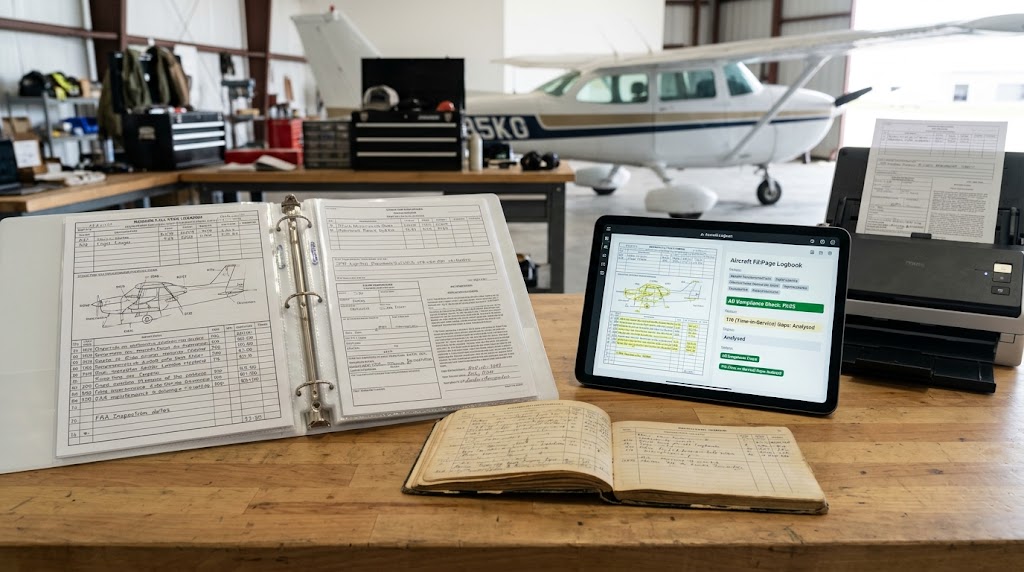
- Start a Full-Page “Volume II”: For many it may be Book 4 or 5 but create a brand-new, 8.5″ x 11″ logbook binder for all future entries. The first entry simply states that it is a continuation of the previous volume, carrying forward the total times.
- Safekeeping your Logs: Providing digital scanned logs to your A&P/IA keeps your logbooks in your safe where they belong.
- Share Digitally: You don’t travel with your logbooks and you don’t always get to perform maintenance at your home base. It also allows your A&P/IA to review your complete digital history remotely before work even begins for routine maintenance, saving them time and saving you money.
3. Total Control During a Sale
When it’s time to sell your aircraft, buyers will hire a meticulous pre-buy examiner to scrutinize your records. If they discover missed ADs, unrecorded repairs, or mathematical errors in total time, you lose leverage in negotiations.
By having up-to-date, AI-analyzed logbooks ready before listing:
- You already know every potential flaw, gap, or question the buyer’s inspector will raise.
- You can address minor entry oversights with your mechanic before putting the plane on the market.
- Providing prospective buyers with a clean, searchable, AI-indexed digital logbook builds immediate trust, accelerates the sale, and justifies your asking price.
4. Why Full-Page Binders Make Everything Easier
Transitioning to 8.5″ x 11″ full-page logbooks (often utilizing standard 3-ring binders) offers major advantages over continuing to cram entries into pocket-sized books:
| Feature | Old-School Pocket Logbooks | Modern Full-Page Logbooks |
|---|---|---|
| Scanning & OCR Efficiency | Requires multiple crops, awkward alignment, and causes bound-spine shadow distortion. | Lays flat on flatbed scanners or document feeders, enabling high-speed, flawless AI text recognition. |
| Data Density & Clarity | Small boxes force cramped, illegible handwriting and vague maintenance descriptions. | Ample room for detailed work descriptions, minimizing the vague entries that often lead to compliance questions. |
| Consolidated Paperwork | Difficult to keep 8130s and supplemental documents attached to the spine. | Standard binders allow you to insert 8130 forms, STC paperwork, and updated Weight & Balance sheets right next to the log entry. |
Modernize Your Records Today
Your aircraft’s logbooks are just as valuable as its airframe and avionics. Archiving your original records, starting fresh with a full-page binder, and leveraging AI scanning guarantees total compliance, safeguards resale value, and cuts down annual inspection time.
Ready to modernize your aircraft records without the hassle?
Contact Us